
Becoming the Ally of All Beings
On the interconnectedness of all things
– Sharon Salzberg
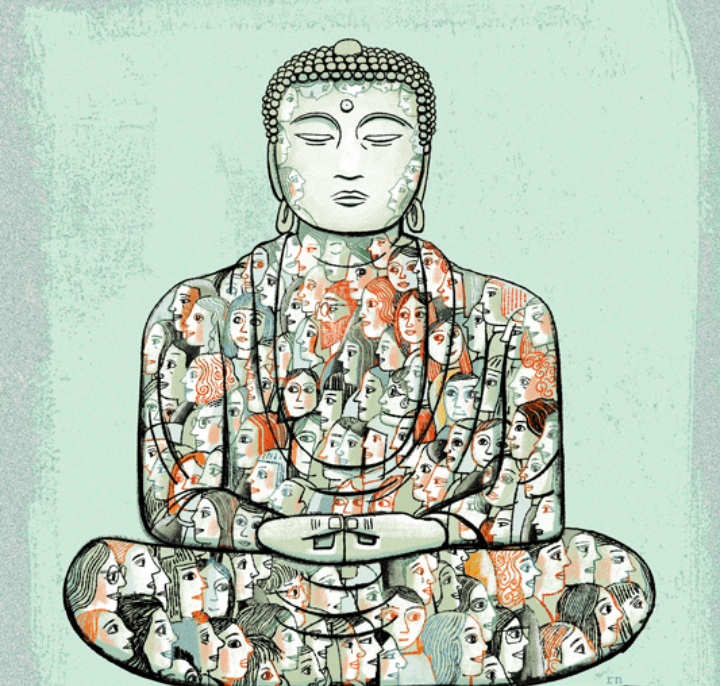
In the Buddhist tradition, bodhisattvas are those who, aspiring to enlightenment, make a resolve, “I vow to attain full enlightenment for the sake of all sentient beings.” That is a pretty incredible vow! It means that we recognize our own liberation is intertwined with the liberation of all beings without exception. It means that, rather than seeing other beings as adversaries, we must see them as colleagues in this endeavor of freedom. Rather than viewing others with fear or contempt, which arises from a belief in separation, we see them as part of who we ourselves are. Seeing the truth of this fundamental interconnectedness is what is known in the Eightfold Path as right view.
The Buddha said, “Just as the dawn is the forerunner and the first indication of the rising sun, so is right view the forerunner and the first indication of wholesome states.” As dawn leads to sunrise, seeing the truth of our interconnectedness leads to the mind-state of loving-kindness that characterizes the bodhisattva. With loving-kindness we become the ally of all beings everywhere. We might think, “That’s impossible. How can I be the ally of those who have hurt me personally, or of those who seem to intentionally hurt others? How can I care about countless beings?”
True, the bodhisattva aspiration does seem to be up against some insurmountable odds. A friend expressed this once to me when we were standing in Red Square in Moscow, which was teeming with people. There were exotic-looking gypsies and people who appeared to be stepping out of another century walking right alongside contemporary business people. Overwhelmed by the sheer numbers and the incredible variety of people, my friend turned to me and said, “I think I’m giving up my bodhisattva vow.”
Loving-kindness is a capacity we all have. We only have to see things as they actually are.
It may seem impossible to genuinely care about all beings everywhere. But developing the heart of loving-kindness is not about straining, not about gritting your teeth and, though seething with anger, somehow covering it over with a positive sentiment. Loving-kindness is a capacity we all have. We only have to see things as they actually are.
When we take the time to be quiet, to be still, we begin to see the web of conditions, which is the force of life itself, as it comes together to produce each moment. When we look deeply, we see constant change; we look into the face of impermanence, insubstantiality, lack of solidity. As the Buddha pointed out, given this truth, trying to control that which can never be controlled will not give us security or safety, will not give us final happiness. In fact, trying to control ever-changing and insubstantial phenomena is what gives rise to our sense of isolation and fragmentation. When we try to hold on to something that is crumbling or falling apart, and we see that not only is it crumbling but we are changing in just the same way, then there’s fear, terror, separation and a lot of suffering.
If we re-vision our world and our relationship to it so that we are no longer trying to fruitlessly control but rather are connecting deeply to things as they are, then we see through the insubstantiality of all things to our fundamental interconnectedness. Being fully connected to our own experience, excluding no aspect of it, guides us right through to our connectedness with all beings. There are no barriers; there is no separation. We are not standing apart from anything or anyone. We are never alone in our suffering, and we are not alone in our joy, because all of life is a swirl of conditions, a swirl of mutual influences coming together and coming apart. By going to the heart of any one thing, we see all things. We see the very nature of life.
Upon closer examination, we come to understand that each aspect of our present reality arises from a vast ocean of conditions that come together and come apart at every moment.
There was a monk in the Buddha’s time, it is said, who originally came from an extremely wealthy aristocratic family. Because he had lived a very pampered life, he was ignorant about some of the simplest things, which made him the object of much teasing by the other monks. One day they asked him, “Where does rice come from, brother?” He replied, “It comes from a golden bowl.” And when they asked him, “Where does milk come from, brother?” he answered, “It comes from a silver bowl.”
In some ways, our own perceptions about the nature of existence may be a bit like those of that monk. When we attempt to understand how our lives work, if we do not look closely, we may see only superficial connections and relationships forming our world. Upon closer examination, we come to understand that each aspect of our present reality arises not from “golden and silver bowls” but rather from a vast ocean of conditions that come together and come apart at every moment. Seeing this is the root of compassion and loving-kindness. All things, when seen clearly, are not independent but rather are interdependent with all other things, with the universe, with life itself.
At the celebration of the twentieth anniversary of the Insight Meditation Society, some young adults planted a tree in the garden. When we look at that tree, we can see it as a distinct and separate object, standing alone, a singular thing. But on another level of perception, its existence is the consequence and the manifestation of a subtle net of relationships. The idea to plant the tree had arisen in someone’s mind as a thought one day, and the idea for some young people to plant it had arisen in my mind another day. The earth that received the tree had been nurtured by a succession of people who had lived at or visited IMS. The twentieth anniversary came to pass because of the enthusiasm and support of so many people over so many years. Each of the young adults who planted the tree had come to have a connection with meditation through varying life experiences.
The tree is now affected by the rain that falls upon it, by the wind that moves through and around it. It is affected by the weather and by the quality of air. We know that pollution creates acid rain, which impacts our tree. We hear that a variable as subtle as a butterfly flapping its wings in China affects the weather pattern in Massachusetts, and so events on the other side of the planet are affecting our tree. Every individual who now sees or touches the tree has arrived at IMS as the result of many forces in the universe converging to make his or her visit possible.
In the same way, we are all part of each other’s life and journey toward liberation. One of my favorite things to do when I am sitting in front of a hall full of meditation students is to sense how many beings brought us all together there in one way or another. How many friends, loved ones, people we’ve had difficulty with, have in some way influenced our life to be there? I think of the lineage of teachers extending from the time of the Buddha, the men, women, and even children who had the courage in life to take a risk, the willingness to be different, to look at the nature of their lives and of their minds in a way that was not conventional. I feel how many people, past and present, are in some way a part of why I am sitting in that hall at that moment, and I sense their presence there too.
I couldn’t even begin to trace the number of influences, encounters, conversations, meetings, partings, times of sharing great joy and times of pain or loss that have brought me to that particular time and place. It’s not exactly like a slide show in my mind; it’s almost more like a kaleidoscope—with just one turn, all of the glass moves and shifts into a new and different configuration and a different pattern.
This is a vast web of interconnectedness that doesn’t seem to have a beginning, doesn’t seem to have any solidity, doesn’t seem to have any boundary.
Loving-kindness is not an object, it is an essential way of seeing that arises when we free ourselves from our normal mental habits that create division and boundaries and barriers, that create a sense of self and other.
Seeing this vision of vastness, of interconnectedness, gives rise to loving-kindness. We look at a tree and see it not as a seemingly solitary, singular entity but as a set of relationships—of elements and forces and contingencies all connecting in constant motion: the seed that was planted, and the quality of the soil that received the seed; the quality of the air, and the sunlight, the moonlight, the wind. That is the tree. In the same way, each of us in every moment is a set of relationships. That is lovingkindness. It is a view rather than a feeling. It is a view that arises from a radical perception of nonseparateness.
In teaching loving-kindness, I have found that people are afraid when they think of it as a sentiment—afraid that they’re not capable of feeling it, afraid that they will feel hypocritical or complacent if they try. But loving-kindness is not a manufactured emotion. As soon as we define it as a certain feeling, we make it into an object, a thing, something we give or don’t give, something we have or don’t have, something we might have to produce on demand, like a card on Valentine’s Day. Loving-kindness is not an object, it is an essential way of seeing that arises when we free ourselves from our normal mental habits that create division and boundaries and barriers, that create a sense of self and other. The practice of loving-kindness is a relinquishing, a coming back, a relaxing into our natural state of mind.
Almost from my first acquaintance with dharma practice, I heard that loving-kindness and compassion were elements or manifestations of the natural state of mind. I would hear that and think, “No way. Look at this world—it’s a mess. I’m also a mess. There’s just no way that these qualities can be the natural state of the mind.” But as I have continued to investigate life, what I’ve come to see again and again and again, without a single exception ever, is that when I see things more clearly, when I can be a little more still and not rush to judgment, when I learn something about somebody or about myself, even if it is just information, when I see a situation or a person more clearly, I am always brought to a greater sense of connection, to a greater sense of loving-kindness. Never has clearer seeing led to more separation or distance, more alienation or fear. Not once.
A friend of mine was a wonderfully empathic therapist. One day a man came to see her, beseeching her to take him as a client. She found his political views alienating, his feelings about women repugnant and his behavior quite annoying. In short, she didn’t like him at all and urged him to find another therapist. However, because he very much wanted to work with her, she finally acquiesced.
Now, because he was her client, she tried to look at his unskillful behavior, and the ways he shut himself off, with compassion instead of contempt and fear. As they worked together, she began to see all the ways in which his life was very difficult. She began to see that he longed—as she herself did—for happiness and how, like her, he suffered. Although she continued to recognize, without denial, his unpleasant behavior, she found that she did so with the feeling that she was necessarily his ally. The goal became his release from suffering. He had become “hers.” Even though I don’t believe she ever liked him, or approved of many of his views, she came to love him.
Love and compassion are not conceptual states, they’re not things we put on as a kind of veneer or pretense, not something we are obliged to parrot, no matter what we are actually feeling. When we let go of our concepts of duality and separation, then love, which is connection, and compassion, which is kindness, arise as reflections of the mind’s natural state. This is not just a nice idea; this is something very real and fundamental.
The Buddha once said, “Develop a mind so filled with love that it resembles space, which cannot be pointed, cannot be marred, cannot be ruined.” Imagine throwing paint around in vast, endless space. There is nowhere for the paint to land. It doesn’t matter whether it was a beautiful choice of color or not. It doesn’t matter, because there is nowhere that the space is going to be painted or marred or ruined by it. When we relax the divisions that we usually make, the mind becomes like space. This is not something that a fortunate few have the capacity to experience; it is the nature of the mind, which every one of us has the ability to know.
We are all bodhisattvas, not in the sense of being saviors running around taking care of everybody’s problems, but through the truth of interconnectedness.
In talking about practice, Tsoknyi Rinpoche, a Tibetan teacher, said we practice in order to learn to trust ourselves more, to get confidence in what we know, to have faith rather than doubt. Loving-kindness and compassion are innate capacities that we all have. This capacity to care, to be at one with, to connect, is something that isn’t destroyed, no matter what we may go through. No matter what our life experience may have been, no matter how many scars we bear, that ability remains intact. And so we practice meditation in order to return to that spaciousness and to learn to trust our ability to love.
We are all bodhisattvas, not in the sense of being saviors running around taking care of everybody’s problems, but through the truth of interconnectedness. There is no separation. We all belong to each other. This, of course, can be a very difficult place to act from in the course of our daily lives. A friend of mine was once home alone when the doorbell rang. When he opened the door, he found himself facing a disheveled, wild-looking person. As my friend attempted to get this stranger to leave, the man looked at him and said sadly, “Don’t you know me anymore?” They had, in fact, never before met. While it was probably wise to refuse the man entry, his words were a tremendous teaching: “Don’t you know me anymore? Don’t you recognize me as a part of your life?” To be a bodhisattva, to open to our capacity for loving-kindness, is more a matter of recognition of our interconnectedness than a dictum for certain kinds of actions.
We are essentially no different from each other, no matter who we are. We share the same urge toward happiness, and not one of us leaves this earth without having suffered. As the Buddha said, “All beings everywhere want to be happy.” It is only due to ignorance that we do the things that create suffering or sorrow for ourselves and for others. If we take the time to slow down and see all the different forces coming together in any action, we will see this desire for happiness even in the midst of some terribly harmful action. While we can and should take a strong stand against harmful behavior, we can do so without disconnecting ourselves from anyone. This is compassion and loving-kindness based on clear seeing.
Just as the root of the Buddha’s psychological teaching is that we will never find happiness in trying to control what cannot be controlled, the root of his moral teaching is empathy—understanding that all beings want to be happy and that suffering hurts others in the same way that it hurts us. We use our mindfulness practice to notice our feelings and to understand them. Through that we can see very clearly that if we are immersed in tremendous anger, it is great suffering. It is a state of burning, of contradiction and isolation, of separation and fear. We see this relative nature of anger as well as its more ultimate, impermanent, insubstantial, transparent nature. On the relative level, it is painful; it hurts. We can learn not to consider anger as bad or evil. We don’t have to reject the anger or reflect or condemn ourselves for it, but rather we can feel compassion for the pain of it. And then we understand that when others are engulfed by anger they are suffering, just the way we suffer when we’re lost in that state.
This quality of empathy is also the basis of modern psychological thought on the development of morality. We learn not to hurt others because we understand how it feels to be hurt. If others are seen as objects rather than as sensitive beings, it’s quite easy to harm. But if we understand, from within, the pain that others would experience from our actions, then there arises a clear and true sense of morality.
Empathy and nonseparation are the most fundamental aspects of loving-kindness. This is what we need to recognize as loving-kindness: a radical seeing of our nonseparateness, knowing our oneness, our indivisibility. When we see through ignorance and arrive at the heart of our interconnectedness, it is as if we had been living in a bad dream, and our anguish and sorrow were born of simply not seeing. From clear seeing arises the uncontrived loving-kindness that is the truth of our bodhisattva nature.
_______
A Loving-Kindness Meditation to Heal Your Inner Child
– Peggy Rowe Ward & Larry Ward
(Dr. Peggy Rowe Ward is an ordained dharma teacher who, with Larry Ward, directs the Lotus Institute)
Thich Nhat Hanh, our teacher, described love as an extremely powerful energy that has the capacity to transform ourselves and others. But many of us find it difficult to direct love toward ourselves. We quickly become aware of negative feelings like shame, guilt, and self-criticism that make it hard to love and care for ourselves. Unfortunately, this is all too common.
Luckily for us, the seeds of love, compassion, joy, and equanimity are in our store consciousness, ready and waiting to grow. We can study and practice in such a way that we shrink the seeds of self-aversion, self-criticism, shame, and guilt inside us and grow our hearts as wide as the world. When we are able to practice self-love consistently, returning over and over to maintain a soft heart in the face of our own suffering, eventually we’re able to let go of our negative thought patterns and find ourselves transformed.
Healing the inner child within us is the first and most important expression of love and kindness toward ourselves.
Thich Nhat Hanh talked about healing the inner child within each of us as a key way to give ourselves the love and compassion we need. For children to feel a sense of belonging, they need to feel understood and loved. They need the feeling of connectedness that comes when they are seen and held in love. But if our parents, teachers, or society didn’t listen to or respond to our fears, or sent messages that we were not good enough, we may continue these behaviors with ourselves as adults. We may disconnect from and bury parts of our inner life because they are too painful to face.
The inner child may hold painful and difficult memories and events that were endured during childhood. Adverse childhood experiences (ACEs) are traumatic events in a child’s life that can have lasting negative effects on our health and well-being.
These childhood traumas can impact our capacity for self-love as a result of unprocessed stress trapped in the body. This is one of the reasons that the following meditation begins by strengthening our heart and mind with the somatic sensations of love and peace.
However, it is important to remember that the inner child is not a separate, unchangeable self. It is not a permanent essence or state of being, but rather deep patterns resulting from many causes, conditions, and perceptions that are both individual and collective. While these patterns may arise in any moment, it is our good fortune that there is a natural neuroplasticity of our brain and mind. This plasticity allows for deep healing and transformation illuminating the divine child hidden in the suffering of adversity.
Healing that inner child within us is the first and most important expression of love and kindness toward ourselves. Here are several ways we can practice love for ourselves, heal the wounds within us, and expand our capacity to love other people, because to fully love others we must first love ourselves.
Send Love to Your Five-Year-Old Self
When we experience our own suffering, the first invitation is to name this experience. In Thich Nhat Hanh’s words, “We call it by its true name.”
Whatever arises, you can name it and send it the energy of loving-kindness. You can say, “I am experiencing the energy of shame and self-criticism. I put my arms of love around these feelings.” Although you are not trying to fix or change anything, the practice of holding your suffering in arms of love will help it to shrink and your self-love to grow.
Perhaps you have an experience of being held this way. A few days after Peggy’s first husband, Steve, passed away, a close friend came to the house. Peggy remembers: “I was sitting on the couch. He put his arm solidly and yet loosely around me and held me for at least half an hour. He didn’t fidget, speak, or move. He didn’t squeeze or pat. He just sat with me. He met me where I was. I cried for many minutes and then experienced a great peace. He didn’t want anything from me. He was just there to be with me in my suffering.”
This is the kind of love in which we hold the suffering child within us.
Sometimes, though, you may experience that the suffering child is afraid to appear. Sometimes it seems this child is in a lost place. Sometimes the child does not trust you. This is to be expected. You will have to move slowly. You have observed that with children and animals, you shouldn’t approach them too quickly. The best method is to let them come to you in their own time.
There are several practices from Thich Nhat Hanh’s tradition that have helped each of us build a loving and trusting relationship with the suffering child within us. One practice is to have a family altar. On this altar, Thich Nhat Hanh encouraged us to have photographs of ourselves as young children. This practice helps us build a relationship that honors our inner child.
A Meditation to Heal Your Inner Child
The following meditation has helped us heal from early childhood experiences. We regularly practice this meditation because it provides a kind space for the body, heart, and mind to gently remember. It offers a living space of inclusivity and compassion for childhood memories and all previous experience as we continue to deepen and grow in self-love.
1. Tap Your Resources of Love and Support
Thich Nhat Hanh once spoke about cooking up love. He reminded us of how we can use pieces of straw or paper to start a good fire. Our resources for love are the pieces of straw that help us generate the energy of loving-kindness.
Resources that help us develop self-love include people, places, pets, activities, and beautiful memories that soften our hearts and nourish our gratitude, love, and compassion. In your practice, take a few minutes to recall such a resource deeply. Make it come alive by activating your senses.
One resource we are both grateful for is the wise and compassionate therapists, body healers, and shamans who have supported our journey of transformation and healing. We often tell our friends that a somatic and trauma-informed therapist can be an essential support person for those on a spiritual path.
A resource that opens our hearts is our dog, Charlie. Peggy imagines the weight of his body in her lap and the feel of his fur under her hand. She pictures his jaunty, bouncy walk and smile. When she brings Charlie to mind, she feels her body relax and her face and eyes soften.
When Peggy needs even more support with her practice, she imagines the Pieta in the Vatican, a beautiful statue by Michelangelo of Mary holding Jesus. She says, “Sometimes Jesus is holding me, but more frequently, I rest myself in the arms of the Mother Mary. Mary helps the mother in me who is learning how to love myself with each breath.”
It is very important to take the time to savor your own resources of love so they are committed to long-term memory. Use all of your senses and anchor these sensations of goodness in your body and mind as you direct the energy of loving-kindness toward yourself.
2. Attend to Your Body
Once we are able to experience the positive sensations of being in touch with our resource, we attend to our body. The first foundation of mindfulness is the body. We love our self by being connected with our body and recognizing the miracle of our body.
Find a place where you can slow down without distraction so that you can be aware of the body and the breath with some degree of comfort. Be thorough in your practice of establishing your posture so that your breath is easeful and you can truly be present.
Scan your body, feet to crown, bringing your mindful attention to your entire body with kindness. Invite your body to relax and soften, settling the body, sinking into your cushion or chair. Thich Nhat Hanh reminds us that this is how we keep our appointment with life. He said, “We stop, we calm, we rest, we heal, and we transform.” Sending this mindful energy of kindness to your body is an act of self-love.
3. Offer Love to Your Inner Child
Then the invitation is to silently offer these words of guided meditation to yourself:
Breathing in, I know that I am breathing in.
Breathing out, I know that I am breathing out
I bring my kind attention to the in-breath
I bring my kind attention to the out-breath.
Breathing in, I am aware of my whole body, right here
Breathing out, I am aware of my whole body, right here
Aware of body, here and now
Breathing in, I see myself as a five-year-old child, fragile and vulnerable.
Breathing out, I smile to myself as a five-year-old child.
Breathing in, I am aware that the five-year-old child is in me.
Breathing out, I hold this child tenderly.
Allow as much time as you would like to experience holding this child that is you. When we first practiced with the little one inside of ourselves, we found it took patience and persistence to connect to the child within. Larry would visualize the child or else he’d visualize a black panther to support his practice. As a kinesthetic learner, Peggy found it helpful to experience the sensation of holding a puppy or kitten. We had to build our relationship and trust by continuing to practice just welcoming this child. Find your own way that helps you to feel solid and at ease.
This meditation has helped us to see ourselves as children and experience the very real vulnerability of human beings. We find that we frequently underestimate our resilience and strength, as well as our fragility and vulnerability. They are not separate. There is great power and strength in our vulnerability and fragility. Being in touch with vulnerability, while it may not be easy at first, is a powerful opportunity to be in touch with life and our own goodness. In doing so, the hidden divine child within can be healed and strengthened.
 HeartMind Meditation