
Dreaming Together
– Nikki Mirghafori
Nikki Mirghafori is a dharma teacher at the the Insight Meditation Center in Redwood City, CA and a stewarding teacher at Spirit Rock Meditation Center, where she is also on the board of directors. Listen to a Dharma Talk on Dreaming Together by Nikki Mirghafori
In the theater of life, emptiness and compassion go hand in hand.
I’d like to talk about emptiness as a way of perceiving. The writer Gay Watson explores a translation of sunyata—first offered by T. Stcherbatsky—that is far richer than the mere lack that “emptiness” connotes: relativity. All phenomena arise in dependence, or relative to, conditions; or, per one interpretation of quantum theory, they exist solely in relation to being observed. Since, according to this interpretation, our act of perceiving is fundamental to the fabrication of our constructed reality, I wonder, could this be one reason the Buddha included perceiving (samjna) in the five aggregates as an essential constituent of our conscious experience?
The word emptiness tends to bring up an image of a dark abyss, a black hole, and people think, “There’s nothing! It’s all empty.” Or worse yet, “Nothing matters.” But relativity, as this translation suggests, means that what we perceive is relative and relies on our framework of recognition (e.g., biological, evolutionary, cognitive, psychological, and sociocultural). It also depends on all the causes and conditions that have supported its existence.
For example, given dissimilar sociocultural conditioning, a member of the East African Maasai tribe would have a different perceived reality in front of a laptop on Zoom than a Silicon Valley engineer would. More radically, different sentient beings have distinct umwelts, or experiential worlds, where their understanding of reality is shaped by their specific biological and cognitive characteristics. The perceptual world of a dog consists of an exceptionally complex landscape of smells and high-frequency sounds, all of which are absent from our subjective reality. Furthermore, whatever is perceived in these disparate umwelts is not independently existing but codependently arising based on many causes and conditions. The creation of a sound requires a vibrating source with the appropriate properties, a medium through which sound travels, energy to create the vibration…just to name a few. Underscoring the immense scale of interdependence, the astronomer Carl Sagan famously said, “If you wish to make an apple pie from scratch, you must first invent the universe.”
Therefore, what we perceive as reality is neither real—reified, fixed, independently existent—nor nonreal. Just as a dream is neither real nor nonreal, so is life. Everything is a dream, but it’s not just a dream—a dismissive stance that veers into nihilism. Life is a dream, and it’s not a dream. In this practice, we neither take an ontological stance that things are rigid as we perceive them to be nor do we deny their existence—neither of the extremes is helpful. The Middle Way of sunyata is to honor relativity and avoid the extremes of independent, reified existence on one end and nihilism on the other.
The late great teacher Rob Burbea talked about life as theater. Imagine you have a front row seat at an engaging play and are fully immersed in the story. You feel the pain, joy, and frustration of the actors. And yet, you realize that it’s theater. Each actor has a role to play. It’s not real! But if we think it’s just theater, we demean the value, the beauty, the grace of the art form. Life is theater in its most beautiful and sacred sense. We can engage with life—this theater-like dream—knowing that we are playing a character in relation to all other characters. The script is not fixed. It has infinite possibilities, albeit each with varying probabilities. And we have an incredible gift: the freedom to choose our perspective, the way we see.
While our minds might crave certainty, relativity invites us to open up to a whole range of possibilities. In this openness, different perceptions can be explored. We’re always looking in a particular way, after all, never putting our lenses down. For example, we can become aware of how we are perceiving, fabricating our reality, starting with moment-to-moment subtle recognitions of arisings in the body-mind and expanding to the stories we concoct about ourselves, others, and the world. Paying attention with interest and curiosity often naturally shifts our perspective. Or, we can intentionally try on (but not force) perceiving from the spacious vantage point of love and letting go, which is the opposite of contraction, clinging, and separation—aka selfing.
Selfing is clinging to negative self-preoccupation. However, developing a healthy sense of self that has integrity and is upright, confident, and beloved is necessary for this path of awakening. It’s often said that you must first know and love the self—“this being who is me,” with all its conditioning, neuroses, and particularities—before you can let it go. If we try to relinquish this self before developing a sense of confidence and care, our practice becomes mired in spiritual bypass. Using sunyata as a hammer to squash and get rid of the self, as some well-intentioned practitioners subconsciously attempt, is painful. Let’s remember the Middle Way. There is this dear being who navigates life, suffers, loves, loses. And yet this is not the whole view. There are more dimensions. Instead of fixating on the perception of my self and my life through a straw—“This is me, this is what I want, this is what I hate, this is me, me, me”—can we expand our perspective to see with love and humor, 360° internally and externally, not taking this self-sense too darn seriously? Remember life as sacred theater.
While navigating different perspectives, it’s also important to maintain flexibility. If I see a friend, it’s not helpful to say “Numerous causes and conditions are giving rise to an image of you being recognized and delight being experienced” instead of “I’m glad to see you!”
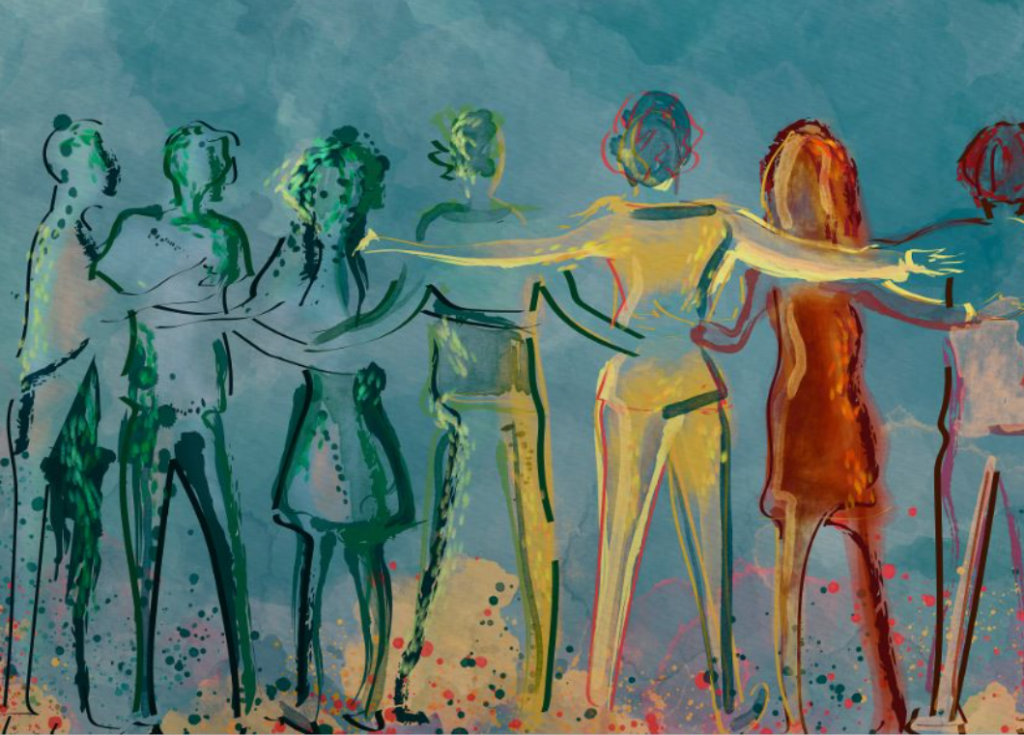
On the other hand, if I’m feeling annoyed, it might be helpful to access other ways of looking. I can see that this friend, just like me, experiences causes and conditions responsible for creating the person that they are. I can recognize their narrative. I could have been born as them and they could have been born as me. In some ways, I am them. We are entangled as we codependently arise in this mess together. We’re not separate. It’s not me versus them. It’s us.
We are entangled as we codependently arise in this mess together.
I notice the impermanent and dreamlike nature of our interaction, and in that moment, my heart opens to tenderness for both of us. We are co-creating and living this mysterious dream together. Or, in the words of Nagarjuna: “Whenever there’s a belief that things are real, desire and hatred spring up unendingly; unwholesome views are entertained, from which all disputes come. Indeed, this is the source of every view; without it, no defilement can occur. Thus, when this is understood, all views and all afflictions vanish entirely. But how may this be known? It is said that when one sees that all things are dependently produced, one sees that all such things are free from birth.”
In Pali, the term yathabhuta nanadassana is often translated as “seeing things as they are.” But this translation posits an ultimate, correct way of seeing things, whereas a more appropriate translation is “seeing things as they have come to be” or as they have come to be seen. Bhuta is the past participle of the verb “to be.” So instead we could say, come and see things as they have come to be perceived, as they have dependently coarisen in our seeing. And when we see in this way, there’s an opening. Emaho! Marvelous! This way of seeing makes life even more mysterious, precious, sublime. It expands the heart in the beauty and generosity of letting go rather than clinging to rigid assumptions and presumptions.
Ultimately, emptiness—as a non-fixed, nonfabricated way of looking—and love and compassion are intertwined. One leads to the other. Love and compassion are particular ways of looking. When we look with kindness and benevolence at ourselves, others, and the world; when we cultivate the way of seeing that is metta, love with no strings attached, we loosen the sense of self and tune our ability to see its fabricated nature. The arrows of love and emptiness fly both ways.
Some years ago, I dedicated a year of my life to the practices of the heart, in particular to metta and compassion. It was a wonderful practice period that gave rise to many insights, including one that I rarely talk about because it’s hard for me to put into words. It was an opening into a perspective that may be described as a glimpse into the “mind of grace.” It was a perspective of complete love and unconditional compassion for everything beyond time and space. No separation, no boundaries, no self—love infused with emptiness, emptiness infused with love. I humbly offer an invitation for you to explore the interchangeable nature of love and emptiness for yourself.
It is said that awakening is an accident, and when we keep practicing, we become more accident-prone. So keep practicing, so that different perceptions pop up when you least expect them and they gradually become readily accessible. Keep relaxing the habitual patterns of perception, and try to see, without forcing, through the eyes of love and nonseparation. You might then notice that you’re looking at every human being as if they are your kin—sibling, mother—and you want to be of service, to help, to heal. But know that you can never go back, because there’s now a crack in self-preoccupation, and the crack is where the light gets in, as Leonard Cohen beautifully said.
Trust your own ability to see—because you can. The Buddha said that if it weren’t possible to awaken, he wouldn’t have shared the teachings. So take heart. Borrow trust—from a friend or teacher who’s further on the path, if you need it—and then verify for yourself how love and emptiness are intertwined.
None of this is heady or meant to be figured out by analysis. It’s meant to be practiced, to be known experientially, firsthand. Find out what happens when you widen your view, consider the causes and conditions of your or someone else’s perspective, or intentionally infuse generosity of spirit into your way of seeing. Maybe the heart releases into more freedom, more care. We can know for ourselves that compassion is the natural response of the heart to suffering. When we’re not entangled in selfing, we want to alleviate pain, to help, to be of service. Come and see for yourself.
_____
Emptiness
– Thanissaro Bhikkhu
Emptiness is a mode of perception, a way of looking at experience.
Emptiness adds nothing to and takes nothing away from the raw data of physical and mental events. You look at events in the mind and the senses with no thought of whether there’s anything lying behind them.
This mode is called emptiness because it’s empty of the presuppositions we usually add to experience to make sense of it: the stories and world-views we fashion to explain who we are and the world we live in.
Although these stories and views have their uses, the Buddha found that some of the more abstract questions they raise — of our true identity and the reality of the world outside — pull attention away from a direct experience of how events influence one another in the immediate present. Thus they get in the way when we try to understand and solve the problem of suffering.
Say for instance, that you’re meditating, and a feeling of anger toward your mother appears. Immediately, the mind’s reaction is to identify the anger as “my” anger, or to say that “I’m” angry. It then elaborates on the feeling, either working it into the story of your relationship to your mother, or to your general views about when and where anger toward one’s mother can be justified. The problem with all this, from the Buddha’s perspective, is that these stories and views entail a lot of suffering. The more you get involved in them, the more you get distracted from seeing the actual cause of the suffering: the labels of “I” and “mine” that set the whole process in motion. As a result, you can’t find the way to unravel that cause and bring the suffering to an end.
If, however, you can adopt the emptiness mode — by not acting on or reacting to the anger, but simply watching it as a series of events, in and of themselves — you can see that the anger is empty of anything worth identifying with or possessing. As you master the emptiness mode more consistently, you see that this truth holds not only for such gross emotions as anger, but also for even the most subtle events in the realm of experience. This is the sense in which all things are empty. When you see this, you realize that labels of “I” and “mine” are inappropriate, unnecessary, and cause nothing but stress and pain. You can then drop them. When you drop them totally, you discover a mode of experience that lies deeper still, one that’s totally free.
To master the emptiness mode of perception requires training in firm virtue, concentration, and discernment. Without this training, the mind tends to stay in the mode that keeps creating stories and world views. And from the perspective of that mode, the teaching of emptiness sounds simply like another story or world view with new ground rules. In terms of the story of your relationship with your mother, it seems to be saying that there’s really no mother, no you. In terms of your views about the world, it seems to be saying either that the world doesn’t really exist, or else that emptiness is the great undifferentiated ground of being from which we all came to which someday we’ll all return.
These interpretations not only miss the meaning of emptiness but also keep the mind from getting into the proper mode. If the world and the people in the story of your life don’t really exist, then all the actions and reactions in that story seem like a mathematics of zeros, and you wonder why there’s any point in practicing virtue at all. If, on the other hand, you see emptiness as the ground of being to which we’re all going to return, then what need is there to train the mind in concentration and discernment, since we’re all going to get there anyway? And even if we need training to get back to our ground of being, what’s to keep us from coming out of it and suffering all over again? So in all these scenarios, the whole idea of training the mind seems futile and pointless. By focusing on the question of whether or not there really is something behind experience, they entangle the mind in issues that keep it from getting into the present mode.
Now, stories and world views do serve a purpose. The Buddha employed them when teaching people, but he never used the word emptiness when speaking in these modes. He recounted the stories of people’s lives to show how suffering comes from the unskillful perceptions behind their actions, and how freedom from suffering can come from being more perceptive. And he described the basic principles that underlie the round of rebirth to show how bad intentional actions lead to pain within that round, good ones lead to pleasure, while really skillful actions can take you beyond the round altogether. In all these cases, these teachings were aimed at getting people to focus on the quality of the perceptions and intentions in their minds in the present — in other words, to get them into the emptiness mode. Once there, they can use the teachings on emptiness for their intended purpose: to loosen all attachments to views, stories, and assumptions, leaving the mind empty of all greed, anger, and delusion, and thus empty of suffering and stress. And when you come right down to it, that’s the emptiness that really counts.
 HeartMind Meditation